Showing posts with label Irish sea pottery. Show all posts

Saturday, August 2, 2014

Beach Combing. Arklow Pottery Mark

Recently I got to go beach combing again for the first time in a few months. As we hadn't had many storms in Dublin, with unusually sunny weather, there wasn't much treasure washed up on the shore but I did get a few beauts.
Irish sea glass and sea pottery, Dublin 2014
The big piece may say 'Riverview' but as it is not that buffed by the sea, it is not the most interesting shard to me. The blue and white, flowery triangle is perfect for a pendant but I will  have to work out a very light wire wrapping design so as not to cover too much of the pattern. The old and gnarled green sea glass at the top is screaming out to made into a rustic keychain. 

However, the creme de la creme is the white piece of pottery near the front with the trademark on it.
Arklow Pottery ironstone mark on sea pottery 
This is clearly an Arklow Pottery mark.  You  can just about make out the words 'Made in Republic of Ireland. Ironstone.' Founded in 1934, Arklow Pottery is very well known here. Most of us grew up eating off Arklow pottery crockery and milking our tea from Arklow pottery jugs. Sadly, the company was eventually taken over by Noritake only to cease production in 1999. But Arklow is still an old staple in many an Irish kitchen. If you've got a few of the older pieces, hold on to them as they are becoming collectors' items.

Ironstone was a type of hardy ceramic that was developed for mass production in the early 1800s in Staffordshire, Uk. What was different about it was its iron slag content. The first potter to coin the term 'ironstone' was Englishman, Charles James Mason, but he was not the only manufacturer to produce this type of delph.

I'm off to research a little into Arklow Pottery trademarks to see can I find out more about this piece. 

In the meantime, if I've sparked an interest in beach combing for sea pottery, you might like to learn a little about it so here are a few older posts to help:

And please click here for some sea pottery jewellery.
https://www.etsy.com/ie/listing/160803745/irish-sea-pottery-pendant-dazzling-blue?ref=listing-12
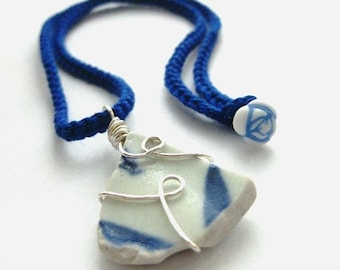
'Sea bird' Irish sea pottery pendant, blue &white


Saturday, June 1, 2013

Curious Sea Pottery Finds

 
Fellow sea pottery nerds out there will understand my delight at finding these curious specimens,  recently on the Dublin shore. If you know nothing about beach combing for sea pottery, click HERE to get acquainted with this addictive hobby.

The dark red and white shard is nicely frosted and there are traces of its original glaze.. It has a raised pattern and I'm not sure which way is up. As yet I have no clue as to what it might come from. The other side is plainer and more matte yet still a deep red shade. It makes me think that it may be a decorative flower pot, bowl or vase, as the manufacture deemed it worthy of colour on both sides. The groove on the outer rim will help when I wire wrap it, but the tricky bit will be to avoid hiding the pattern.

This is obvioulsy the drainage hole from the bottom of a terracotta flower pot. It's a fun find, but a little clunky for making jewellery. But I have a couple of ideas in my head for a quirky ornament, perhaps for a garden.

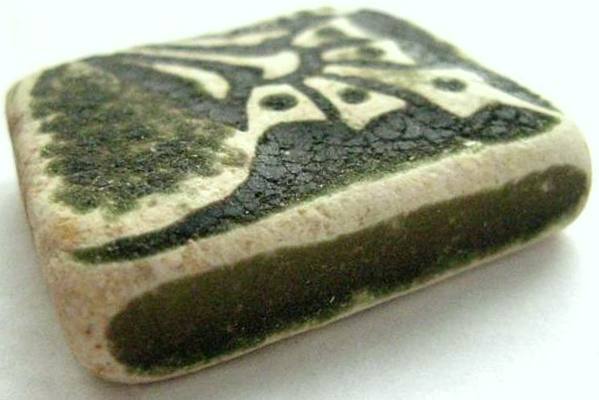
Finally, the piece de resistance; a beautifully intact, patterned, green tile. It is about the length of a matchbox and as thick as the tray inside one.  It is well frosted and leeched by the sea but the colour is still true, if a little enhanced by sea flora. It is probably a few decades old but not of the same vintage as most of the pieces I have found. Much of the beach-worn sea pottery washed along the Irish coast tends to be 19th and 18th century. This may or may not be old, but its good condition means it has not been in the sea for 100 years, more like 10 to 40, at a  guess.

 I've only given it a rinse out as I haven't figured out the best way to clean it without fading it or damaging it. I shall probably revert to the safest means a good soak in washing up liquid and cleaning with my hands, and absolutely no scrubbing brushes. An artist's paintbrush may come in handy.  If anyone recognises the pattern or what exactly it might be, I'd love to hear from you. 

I'll be back with some lovely pieces of sea glass and sea pottery which are currently soaking in soapy water.

Happy beach combing!