Showing posts with label legend. Show all posts

Sunday, February 15, 2015

The Irish Claddagh Symbol

This week I listed an OOAK Connemara marble pendant featuring a vintage, sterling silver Claddagh charm.

The Claddagh heart is a well-known and internationally popular Irish design.  The Claddagh ring was the original format, and has been about for 300 years or so, but charms, pins and engravings based on the design are also found. This particular charm that I used is a sold silver pendant from the 1980s.

This famous design features a crowned heart clasped by two hands, which are clothed in gauntlet gloves. The hands symbolise friendship, the heart, love and the crown stands for loyalty. There are many modern variations in the design, including those with two hearts instead of one.

There also exists a variation without a crown, called the Fenian Claddagh. Historically it was adopted by Irish rebels who refused to recognise British rule.

ORIGINS
 
This class of ring belongs to a wide group of rings called Fede rings, which involve clasped hands in the design. Fede, (or Faith) finger rings date back to the Romans. However, it is not known when exactly the first Claddagh ring incorporating a heart was made, though it is believed to be a 17th Century development. It wouldn't be Irish without a few stories and legends surrounding its origin...

Claddagh was a small village outside Galway city, but is now part of the city itself. The oldest surviving Claddagh rings date back to the 1600s. Some of those bear the signature of Galway artisan, Bartholemew Fallon. 
There is a popular belief however, that the artist who first made the ring was a contemporary of Fallon's, fellow Galway man, Richard Joyce. He was kidnapped by pirates and sold to a Moorish goldsmith as a slave. He meticulously learned his master's craft and gained the respect of the goldsmith. When he was eventually released, he returned to Ireland where he put his smithing skills to use and created the famous ring. His branding and initials are also believed to be on some of the oldest surviving of these rings. 

However, Irish stories nearly always involve things happening thrice, so not surprisingly, there is a third goldsmith from the era also accredited with designing the ring, Thomas Meade of Kinsale. 

Who is to say which, if any, of these three jewellers was actually the first to design this famous emblem?
Those who prefer a more mythical view will tell you that the first Claddagh ring was dropped by an eagle into the lap of one Margaret Joyce, widow to a Spanish merchant named Domingo De Rona. Allegedly the majestic bird gave it to her as a reward for her charitable works.
Today the  Claddagh ring is popular, particularly with the Irish diaspora, as a wedding or engagement ring.

The pendant and other variations are more often given as a gift of friendship. Whatever shape or form it comes in, the Claddagh motif is a powerful symbol of pride in Irish heritage.  I thought it very fitting to team the Claddagh charm with a gorgeous slab of indigenous Connemara marble, another intrinsically Irish treasure.

More from this blog:
Celtic Influences in my Designs
A little about Connemara marble 


Sunday, May 18, 2014

ABC. F is for Fairies, Fluorite, Feldspar and Fan Necklaces

Continuing my ABC of Jewellery, (a not-so-comprehensive guide to jewellery, jewellery making techniques and materials I use, design inspirations etc) F is fun and fantastical with Fairies! In terms of materials it includes Fluorite, Feldspar and Findings and in design it brings us to Fan necklaces.  Encompassing a huge array of crafting supplies,  'Findings' will get a post all of its own next.


Fluorite is a semi transparent gemstone. It is the mineral form of Calcium Fluoride and comes in so many hues it has been nicknamed 'the most colourful mineral in the world.' The most common shades are blues, purples and greens, and next is yellow or clear. Often it boasts more than one tone and can have gorgeous banding.


The ancient Egyptians and the Chinese have carved the mineral for decorative purposes for centuries. In the 1700s the mineral was believed to cure ailments of the kidney. Apothecaries would grind the fluorite into a powder to be dissolved in water and ingested as medicine. Please do not try this at home folks!
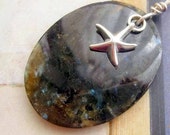
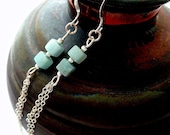
https://www.etsy.com/ie/listing/60254054/labradorite-pendant-starfish-sterling?ref=shop_home_active_9https://www.etsy.com/ie/listing/26157924/amazonite-gemstone-earrings-sterling?ref=shop_home_active_1&ga_search_query=amazonite
Feldspar is a large group of rock forming minerals. Forming approximately 60% of the earth's crust, it is the most plentiful mineral group on the planet. (You  can find the science bit HERE on Wikipedia.) The name comes from the German 'feldt spat,' meaning field stone. Seemingly when it erodes, it releases nutrients such as potassium into the soil, enriching plant life.


The feldspar gemstones most often used for jewellery are amazonite, moonstone, labradorite, obisidan and a black tourmaline (schorl tourmaline.) 
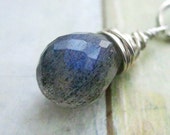
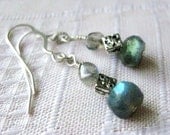
https://www.etsy.com/ie/listing/90710934/blue-flash-labradorite-pendant-sterling?ref=shop_home_active_4&ga_search_query=labradoritehttps://www.etsy.com/ie/listing/183590520/labradorite-earrings-blue-flash-gemstone?ref=shop_home_active_4


Of these, labradorite is my favourite. It is a feldspar found mostly in Labrador, Canada and is famed for its blue flash when it catches the light. Metaphysically, the stone is associated with the delaying of aging but let's not tell the skin cream companies.

https://www.etsy.com/ie/listing/175447532/red-gemstone-necklace-statement-bib?ref=shop_home_active_2
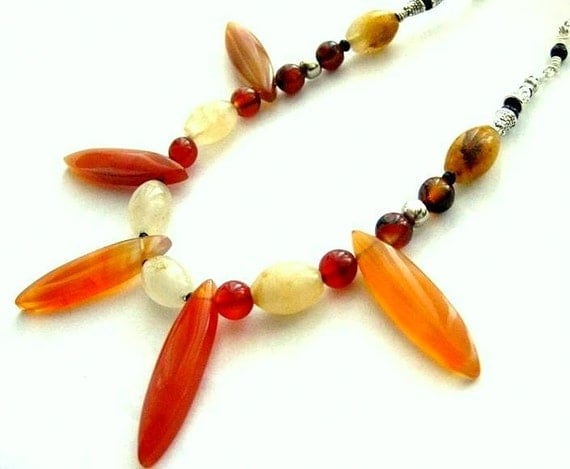
red gemstone fan necklace
F is also for Fan necklaces, a currently popular style of chunky, statement neckwear and a cousin of the collar neck piece. As the name suggests, it is designed to fan out and is therefore, an excellent choice for breaking up a wide area of skin when wearing low necklines. It also can create a little drama worn over a high, plain neckline. The style has origins in tribal, African jewellery and other ethnic cultures including Native American, Amazonian, Aztec, Egyptian and more. The fan shape in this carnelian necklace is created with petal-like stones, drilled laterally at the top.

https://www.etsy.com/ie/listing/168874285/irish-fairy-ornament-sea-glass?ref=shop_home_active_1&ga_search_query=sea%2Bglass%2Bfairyhttps://www.etsy.com/ie/listing/170299846/butterfly-fairy-charm-carnelian-rear?ref=shop_home_active_3&ga_search_query=fairies


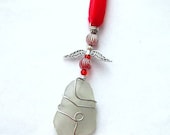
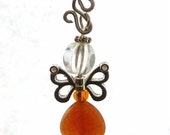
Ireland is a land associated with Folklore and Fairies, so they naturally belong in my collection.You can find 2 types of Fairies (and/or angels) in my inventory; larger sea glass ornaments and smaller, beaded charms or pendants.
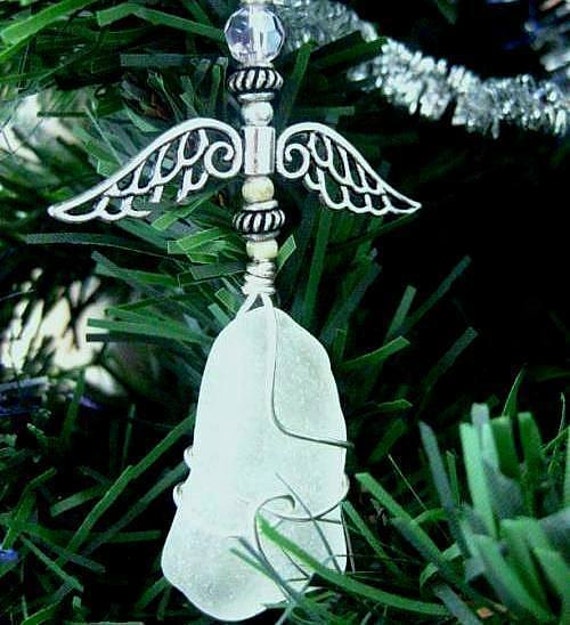
sea glass fairy angel ornament or sun catcher
I wire wrap more unusual sea glass fairies, which are a type of art doll or home decor and usable as sun catchers, Christmas ornaments and large pendants for adults. They are not suitable as toys or as pendants for children but do make pretty nursery decorations to hang out of reach. 


Genuine sea glass has been tumbled, smoothed and frosted by the ocean over several decades. I believe the wire work should be just as aesthetic as the glass without overwhelming it. I have developed my skills to create a style of wrapping that is lightweight and pretty in appearance but very secure. This shows off the glass and makes for very light and airy looking sea glass fairies.

Irish belief in fairies goes back to, at least, Celtic times and is much more complex than our love of whimsy and story telling.  I found this interview with Dr Jenny Butler, Folklorist and Lecturer, very interesting from a social history point of view. Be aware, it's not short, so pop the kettle on.

***

CLICK HERE FOR THE ABC SERIES SO FAR

or by letter:
A  B  C  (plus C for Crimping D E