Showing posts with label beach glass. Show all posts

Sunday, June 12, 2016

Seaglass Bottle Stopper

One of my favourite pieces of beach treasure is this intact, sea-tumbled bottle stopper that I found on a shore near Dublin. Originally a club sauce stopper, it is quite a rare find. Isn't it simply gorgeous?
seafoam seaglass bottle stopper
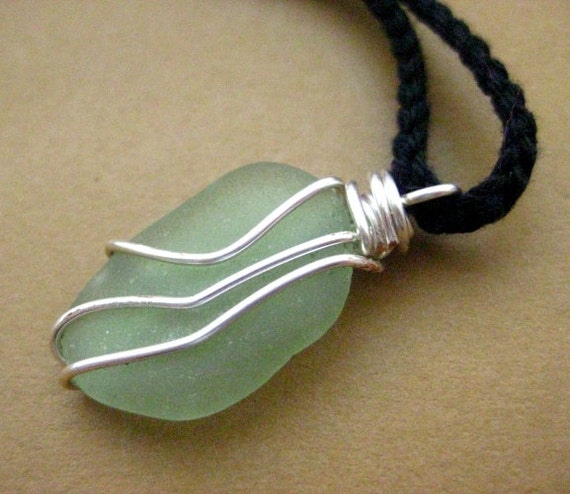
fully frosted seaglass pendant
Natural seaglass is glass that has spent decades tumbling in the salty waves of the ocean. The silt, rocks and elements polish and smooth any ragged edges. More importantly, the water eventually leaches minerals, namely sodium and potassium, from the glass, causing that frosted or etched look that cannot be faked. Only time and tide achieve it. A highly frosted piece must have been in the sea for well over 100 years. 

Glass bottle stoppers were particularly popular in these parts in the 1800s before solid cork stoppers became more commonplace. Flat-top stoppers with cork sheaths around the shank were much used for sauce bottles from the mid 19th century. Not surprisingly this style is known as 'Club Sauce Stopper.' The cork would have eroded away in the sea decades ago. Today glass stoppers are still found in retro-styled perfume and apothecary bottles, for example. 
partial sea glass bottle stopper
 This partial piece was found on a North Dublin shore. The round rim has been eroded right away but you can still tell it is an antique bottle stopper. It is a beautiful teal colour. 

This intact one was found on a South Dublin shore and is a lovely seafoam colour. This greeny aqua tint often seen in old seaglass is caused by the iron content in the sand used to make the original glass.

 I don't intend wrapping it into a piece of seaglass jewellery. This beauty is more of a collector's item to hold onto for the joy of having found it.

*****

Want to see some rare red seaglass I found? Please click here
Click here to see some interesting shapes in white seaglass

Sunday, June 29, 2014

Recycling Project. Candle Holder with Small Seaglass Pieces


Small pieces of colourful Irish seaglass
 What do you do with those little tiny pieces of frosted seaglass that wash up on the shore? I have a bunch of them that are way too small for wire-wrapped jewellery and ornaments. The colours are beautiful and it's a shame to waste them. Most of them are fully frosted so they have probably been tumbling in the sea for decades and it's lovely to be able to recycle them. Here's one very simple idea as to how to display them by making an eye catching candle holder.

(To learn how to clean seaglass  firstclick HERE)


As this is a recycling project, I decided to re-use this small, glass, ramekin dish that came with lemon souffle in it. (Yummy!) At just over an inch high (c28mm) and slightly more than 3 inches in diameter (c78mm), it is the perfect size for displaying a tea light candle.


First I put the small tea light in the centre of the ramakin. After placing the small seaglass around the candle, I carefully filled the dish with water, falling short of the top of the candle by about half a centimetre.
The colourful pieces of sea glass remind me a bit of those sugary, jelly sweets small kids love.
The fluted design of the dish throws gorgeous patterns of light. The candlelight picks up some soft colour from the seaglass in the water. Three of them would make great centre pieces along a table. Only two lemon souffles in a pack...I'd best go and get some more so.

To learn how to clean seaglass click HERE
To learn how to clean seaglass jewellery click HERE


Friday, February 7, 2014

B is For Beads, Beach Glass, and Bottle Stoppers

We're on the letter B in my ABC blog series. This is a not-so-comprehensive guide to jewellery materials and tools that I use and some tips for care of your jewellery etc. B is for beads, beach glass and bottle stoppers...

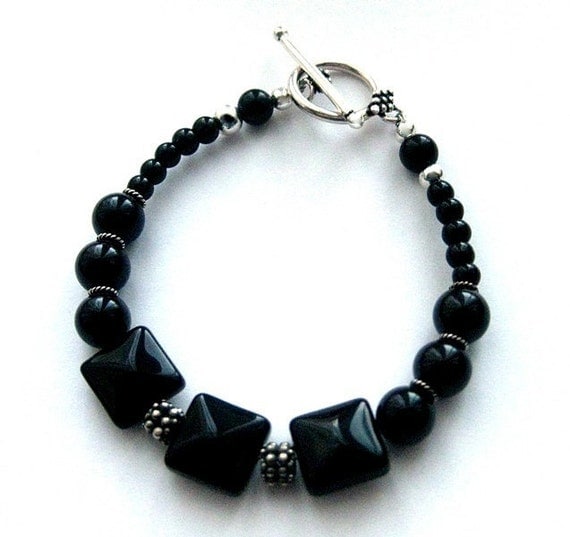
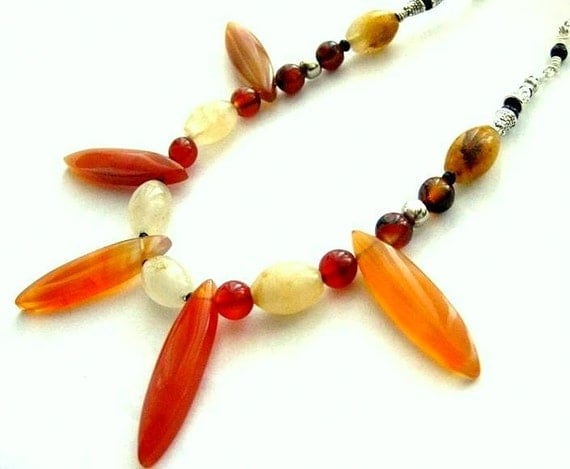
Black Onyx Bracelet, Sterling Silver. Medium. 7.5 inches. Midnight in Dublin Red Gemstone Necklace. Statement Bib. Celosia Orange Carnelian, Agate & Citrine. Tribal Flame

Beads are small, pretty or decorative things for threading (stringing,) weaving or wiring into, sewing onto to otherwise embellishing jewellery, clothing, accessories etc. They come in a wide range of sizes and shapes and are made from a vast array of materials. Most commonly beads are created from glass, wood, metal, stone, ceramic, clay and crystal.  Beads are increasingly being made from interesting recycled sources such as paper, fibers, up-cycled plastic and recycled metals and so on. 
world’s oldest manufactured beads
photo courtesy of University of Oxford
The oldest known beads are drilled Nassarius (sea snail) shells,  discovered in Eastern Morocco., South Africa and Israel. The oldest are believed to be c100,000 years old. 

The sea glass I use is not technically a bead as I don't drill any holes in it. However, this red sea glass bead is one of my most prized beach finds. It is most likely a fisherman's bead that would be threaded onto the line to attract the fish. It is beautifully frosted which indicates it is a few decades old and it still has a piece of line stuck inside it.

If you are starting out as a beader and intend purchasing beads online it would be wise to familiarise yourself with bead sizes, at least the more commonly used ones first. The smallest can be under 1mm, a mere dot! Those that measure 4mm and under are usually used for accenting (flanking or separating) larger beads or for very delicate bead work.  

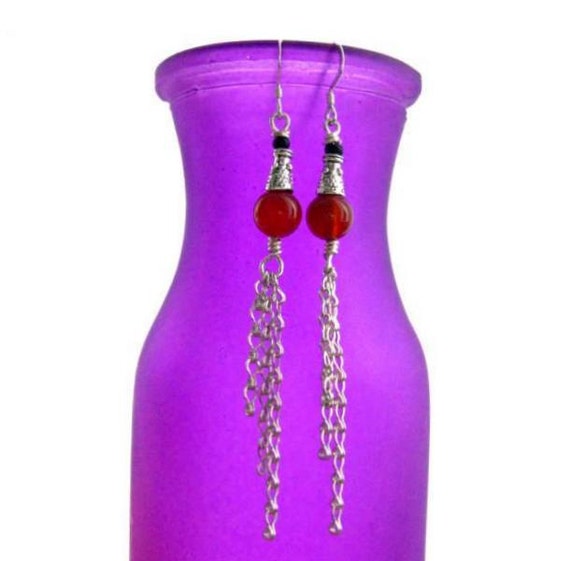
long carnelian and onyx earrings


A bead chart can be useful for gauging sizes. For beginners who want to learn with simple earrings, bracelets and threaded necklaces, I would recommend starting out with 6mm, 8mm and 10mm. The carnelian beads in these dangle earrings are 8mm and the black onyx are 2mm. Once you are familiar with these sizes you will find it easier to guess what other sizes will look like.


B is also for Beach Combing and Beach Glass
In Dublin city, it's relatively easy to get to the coast for some beach combing. I collect and use beach glass and sea pottery. Personally, I'm not a fan of shell jewellery. You are more likely to pick up some decent beach glass near a harbour, or in the tiny pebble coves than on a long sandy strand.

People often ask the difference between sea glass and beach glass. Sea glass is glass that has been naturally tumbled and frosted by salty, ocean water and is found on coastal strands. Glass that has been tumbled naturally by fresh water in lakes and rivers is called beach glass. Beach glass is also the wider term for both categories...in other words, sea glass can also be termed 'beach' glass but the reverse is not so.  Sea pottery can also fall under the term 'beach glass.'
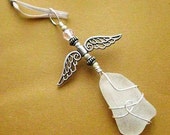
 Irish Angel. Sea Glass Fairy Suncatcher, Christmas Ornament or Rear View Mirror Charm
A fully frosted and smoothed piece of beach glass would have been surfing the waves getting buffed by the silt for decades. Frosting occurs when minerals are leeched by the elements over a long period of time.

I have written a number of previous posts around the subject including:
How to Clean Beach Glass
How to Care for Beach Glass Jewellery
A Little About Sea Pottery

bottle stoppers I found in Dublin
B is also for bottle stoppers - my favourite beach finds to date. Glass bottle stoppers were popular in these parts in the 1800s. This piece would have originally had a cork sheath around the shank and would have come from  a sauce bottle. Read more about the club sauce stopper HERE.


Wednesday, October 3, 2012

Who Says White Seaglass is Boring?

White Seaglass
White or clear is the most common colour of natural seaglass found. That doesn't mean it's never of interest.  Recently I found several cool pieces in fabulous shapes. They were of the clean-looking, pearly white variety. The odd-shaped nugget on the left is destined for a keychain methinks. The others may end up as pendants or Christmas ornaments...I will know when I go to wrap them in silver.
 All of them are heavily frosted, so must be several decades old. Frosting occurs when the soda and lime are leached naturally from the glass by the sea. This is a very long process and it can take a 100 years or so to produce a really 'crusty-looking' piece.


Found on a Dublin shore, this fan-like, sun-ray design is stunning. I would hazard a guess that this piece is from a bowl or decorative dish of some sort. It reminds me of some of my Mum's Irish crystal. Wrapping it in silver wire will be a challenge as I don't want to cover up the pattern, but rather, work with it. I am half tempted to use this as a paperweight (though I have to admit, paperweights are surplus to my needs and I'm not a big fan of shelf brick a brack.)
This shell-like piece reminds me of a certain potato crisp (chip to you in the USA.) It will make a pretty pendant as it is the perfect size and shape.
frosted seaglass bottle stopper
 I was thrilled to find this bottle top. It's especially rare to find one of these on the Irish coast.

Unfortunately, it's not completely intact but it is nonetheless, a very special find. Again, I may keep this one but if I decide to wrap it, it will present an interesting challenge.

White seaglass may not be so rare, but you can make lots of beautiful things with it. Here are some of the items I've made from white seaglass:


(fairy ornament, sold)


To learn about shades of BLUE seaglass click: HERE
To learn about shades of GREEN seaglass click: HERE
To see PALE (SEAFOAM ETC) shades of seaglass  click HERE

To find out how to clean seaglass and sea pottery click HERE


Thursday, September 20, 2012

Killiney Caught My Eye 9

Caught My Eye is the section of my blog that I reserve for scenes that struck me as curious, comical, weird, or aesthetically appealing when out and about on one of my rambles. Please forgive my amateur photography and enjoy the photos for what they are - a glimpse at the world that I find so inspiring.

The sea close to Killiney, Dublin this summer. As for many an artist, writer or poet, the ocean always inspires me to get creative.


 The colour of the water was particularly gorgeous that day in August. It was a stunning shade of bluey-green I wouldn't normally associate with the formidable, dark Irish sea.

Aqua blue sea glass pendant from Ireland
We didn't spend long on the stony beach as the heavens were about to open. I found only one solitary piece of usable sea glass on the strand in the twenty minutes or so we were there. But it was of the rare, aqua blue variety, so worth it. Above is the pendant I made from it: aptly named 'Cool Water.'

Friday, September 7, 2012

Recent Red Seaglass and Pottery Finds

 
 Red is one of the rarest and most valuable of colours to find in genuine seaglass. Every seaglass beachcomber hopes to come across a piece or two. This is the first specimen I have ever been lucky enough to discover. It's small, but it's complete and I love it!
When I spotted it among the shingle on a Dublin beach, at first I thought it was a sweet! It is the right size and shape and of course the bright colour does look as tempting as candy. No wonder I mistook it for a sugary treat, but that was partly because I couldn't believe my luck. Thankfully I didn't discard it!

Once I got it cleaned up in soapy water I knew for sure it is a seaglass bead. It might be one of those bright beads used on fishing lines to attract fish. There was a piece of old, rotted and rusty-looking wire or beading string inside it, which came out while cleaning.

There is still a black stain running through the centre. I'm not sure if I will be able to remove that.  I will try running some lavender oil through it. Lavender oil is usually good for removing black marks on seaglass and as a bonus, it is antibacterial. It's worth a try I guess.
Last week I took a trip out to Skerries, a seaside town, North of Dublin. Though it was a beautiful day, the beach was practically deserted and very clean. I found not one single piece of beach treasure on the super clean strand, but as the tide was out we were able to poke about in the rocks and shingle leading around to the harbour. Though I had a disappointing yield, I did find one or two very interesting pieces.

My friend picked up this red and white, semi-opaque seaglass. It's an interesting find, but it might also be worth nothing, except for its lovely colour. I don't know much about this type of glass yet.

I do know that fully opaque sea glass or milk sea glass as it is often called is considered to be a poor relation to the transparent sort. However, I can't quite classify this piece as such. It reminds me of semi frosted, vintage vases and dishes, the kind your Granny might have had. Perhaps it is better described as sea pottery. Or perhaps it is just milk sea glass that has not been in the sea long enough....something for me to research so...
On a recent break at Rosses Point, Sligo, I found this cute piece of sea pottery with a red, floral design on it. It is beautifully 'chalky' or sea-worn and is probably very old. Well-worn sea pottery found in Ireland is often 100 years old or more.

This piece is the ideal shape for wire wrapping a pendant. It's not very large, but by the time I  have it wrapped with a bail on top, it will become a decent, medium-sized pendant.

In the meantime, I dream of one day finding a really great, pendant shaped and fully frosted 'ruby of the sea.'


To learn about shades of BLUE seaglass click: HERE
To learn about shades of GREEN seaglass click: HERE


Monday, September 3, 2012

Seaglass Bottle Necks and Rims


seaglass bottle necks and rims
Natural, sea-tumbled bottle necks and rims are much coveted by seaglass collectors and jewelry designers like me. As with bottle stoppers, patterned glass, frosted marbles etc, they are considered a rarity.
Teal seaglass pendant by Handmade by Amo'r (SOLD)


If you find a specimen in a rare colour such as red, pink, 'vaseline' (glow in the dark), teal, cobalt etc, then lucky you! You've got a true collectible.
seaglass bottle necks and rims from Dublin
Over this summer, I have found a few bottle necks and rims on various beaches along the East coast of Ireland. These shapes are fun to wire-wrap for jewellery and can become unusual, eye-catching conversation pieces.

The forest green and brown pendants on the right are slightly concave but have no tell-tale ridges. I'm almost sure the green one in particular comes from the 'shoulder' and long neck of a bottle, probably one that held wine. 
The olive green bottle neck piece on the left is much rarer, not only because of its shade, but also due to its distinctive rim. I will be listing the pendant in my Etsy shop  pretty soon.
kelly green, Irish  sea glass pendant
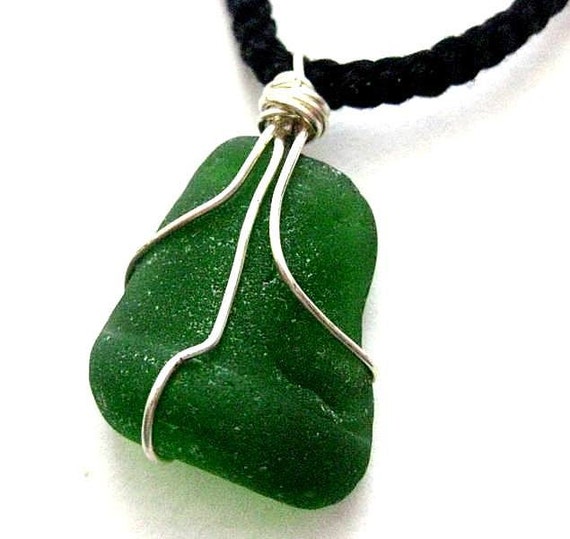
'Ocean Jewel' seaglass pendant is made from part of a kelly green bottle neck. If it came from a beer bottle, then it is quite possibly, close to 100 years old.

Around 1930 it was discovered that brown glass did a better job of preserving beer and so green glass was discontinued for this purpose. Yes, we use green bottles again today as we have better refrigeration and nowadays beer rarely needs to be stored for a terribly long time anyway. However, if this were a modern piece of seaglass it would be smoother, with very little of the tell-tale, crystalline frosting that occurs only after decades in the sea.

Of course, the seaglass could also be from a wine bottle, but it is nonetheless, very old. Frosting occurs when soda and lime are leached from the glass by the water. This is a very slow process. Heavily frosted seaglass is usually 50 to 100 years or so old. Perhaps this piece fell from a trading ship bearing wine from overseas. Its history is held forever secret by the Irish Sea.


Tuesday, August 21, 2012

30 Shades of Pale

There really seem to be several shades of pale when it comes to seaglass. Here is a glimpse at some of the lighter and whiter pieces I have been wire wrapping recently: I have not played with the colour in the photos.  All the specimens were found on Dublin beaches.
 Pale aqua and seafom seaglass pendants  

None of the above are exactly 'white seaglass' as they all boast aqua or seafoam undertones. The greenish, seafoam shade is caused by the iron content of the sand used to manufacture the original glass. Though I often see very pale shades like the one on the left being called seafoam, I wonder if 'white-washed' wouldn't be a bit more accurate.

The second from the left has more than a tinge of  bluey-green to it, which comes up even deeper and richer in low lighting.  

White seaglass ornaments or pendants


Above are examples of true white seaglass for comparison purposes. If you'll grant me one pun, the difference is clear.


To learn about shades of BLUE seaglass click: HERE
To learn about shades of GREEN seaglass click: HERE