Showing posts with label beading. Show all posts

Thursday, February 27, 2014

C is for Crimping. How to Finish a Beaded Necklace

The letter C in my ABC series brings me to the subject of crimping and a whole lot more: Connemara marble, Cork red marble, copper, chalcedony, carnelian, chasing hammers... So much in fact, that I decided to separate out the technique of crimping into a blog post of its own.

Crimping is a secure and professional way to finish off beaded jewellery in lieu of knotting. Personally, I would use a knot only if beading with elastic for a stretchy bracelet, but with  tigertail (nylon coated steel beading wire) for me, it's crimping all the way. 
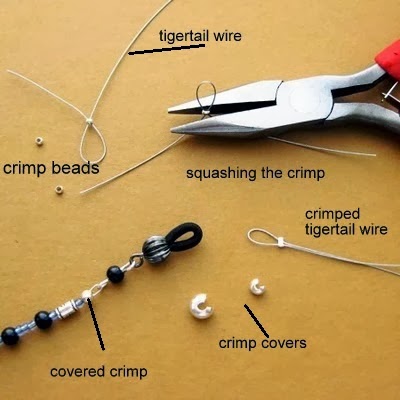


Crimps are tiny metal beads which you thread onto the ends of a beaded string and crush flat to hold the beads in place. They cling to wire holding it fast. I prefer this method over knotting as it is durable and quite simply, I'm better at it and more able to get in really close to the last bead for a smooth finish. It also eliminates any possible need for using glue. Glue and me often come to a sticky end. You can get a special crimping tool to help but I use the traditional flat nose pliers for crushing and employ crimp covers for a neat finish.


beaded eyeglass chain finished with crimps & wire guards
Crimp covers are fold-over metal beads that give a sleeker, safer finish. Crimp covers come in a range of metals, precious included. For extra durability I often double crimp, especially in a big or heavier necklace and for bracelets, which can get rougher treatment as the wearer goes about their daily business. 


Double crimping is unusual, but it is one of the features of my hand work that makes it extra special. Here is how I finished this big statement necklace for a custom order:


For a heavy necklace like this I also use two strands of tigertail for extra strength. I began by making the beaded link to the clasp, then looped the string onto it. Next I threaded on the first crimp about 1mm from the end and crushed it flat. You have to be careful not to let the wires cross over inside the bead or it will be weak.


The next stage is to grip a suitably sized  crimp cover and place the crushed crimp into its 'mouth' then gently fold it closed with the pliers. Sterling silver covers are quite soft and easy to squish out of shape so this is a delicate operation. 


Very light tapping and squeezing gets the cover properly lined up and sealed smoothly. Most beaders do not double crimp but I like to as the second crimp takes some of the weight off the first one. I usually separate out the crimps with a bead that matches the piece, so making them part of the design. 
The stones and beads go on next and the trickiest part is finishing the strand. Bead your crimp(s) on but don't crush yet. For this heavy necklace I used two lengths of tigertail and both strands would be doubled back to pass through the crimps again, so extra wide crimps were required.
Loop the tigertail onto the clasp (wire guards may be used if desired. See photo of blue eyeglass leash at top of article). Double back to thread through the crimps and the first 2 or 3 beads. Make sure to trim the wire to such a length that it will hide inside a bead. I've done this bit super loosely just for the photo before pulling it tight.


Once the wire is tucked away and beads are in position, only then are the crimps crushed and covered.
Onyx & oxidised silver necklace (custom OOAK order)
See how the covered crimps are now part of the design? The double string and double crimping makes this big necklace extra strong.


*** *** ***
Watch this space for part 2 of the letter C 
Click HERE to see all posts in the ABC series

Friday, February 7, 2014

B is For Beads, Beach Glass, and Bottle Stoppers

We're on the letter B in my ABC blog series. This is a not-so-comprehensive guide to jewellery materials and tools that I use and some tips for care of your jewellery etc. B is for beads, beach glass and bottle stoppers...

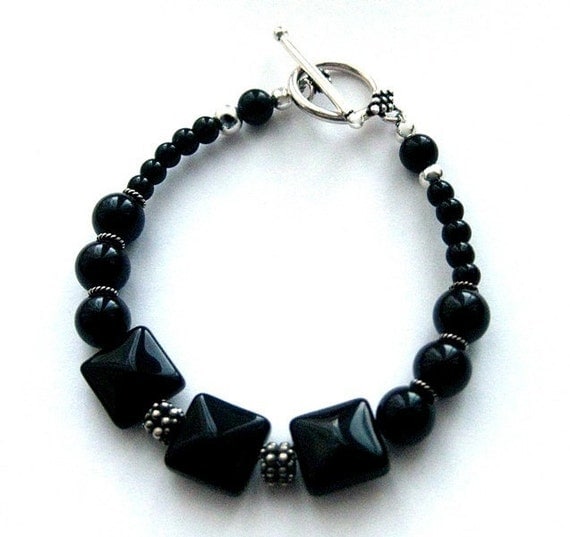
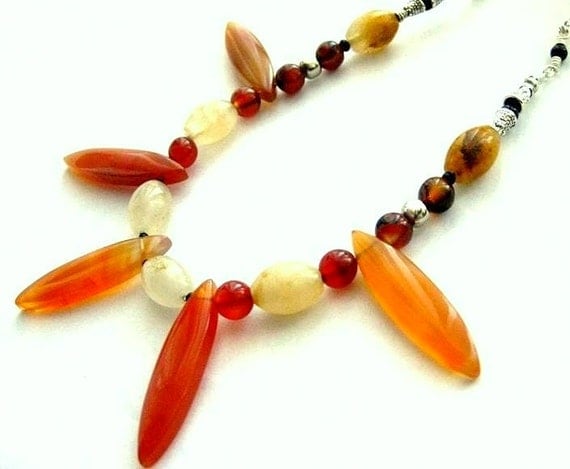
Black Onyx Bracelet, Sterling Silver. Medium. 7.5 inches. Midnight in Dublin Red Gemstone Necklace. Statement Bib. Celosia Orange Carnelian, Agate & Citrine. Tribal Flame

Beads are small, pretty or decorative things for threading (stringing,) weaving or wiring into, sewing onto to otherwise embellishing jewellery, clothing, accessories etc. They come in a wide range of sizes and shapes and are made from a vast array of materials. Most commonly beads are created from glass, wood, metal, stone, ceramic, clay and crystal.  Beads are increasingly being made from interesting recycled sources such as paper, fibers, up-cycled plastic and recycled metals and so on. 
world’s oldest manufactured beads
photo courtesy of University of Oxford
The oldest known beads are drilled Nassarius (sea snail) shells,  discovered in Eastern Morocco., South Africa and Israel. The oldest are believed to be c100,000 years old. 

The sea glass I use is not technically a bead as I don't drill any holes in it. However, this red sea glass bead is one of my most prized beach finds. It is most likely a fisherman's bead that would be threaded onto the line to attract the fish. It is beautifully frosted which indicates it is a few decades old and it still has a piece of line stuck inside it.

If you are starting out as a beader and intend purchasing beads online it would be wise to familiarise yourself with bead sizes, at least the more commonly used ones first. The smallest can be under 1mm, a mere dot! Those that measure 4mm and under are usually used for accenting (flanking or separating) larger beads or for very delicate bead work.  

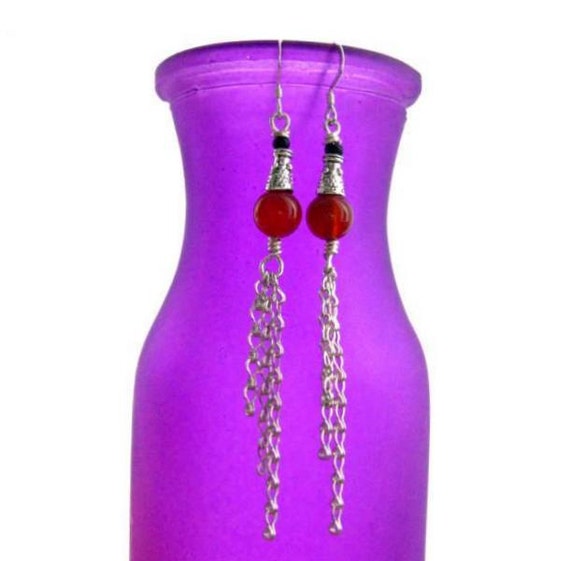
long carnelian and onyx earrings


A bead chart can be useful for gauging sizes. For beginners who want to learn with simple earrings, bracelets and threaded necklaces, I would recommend starting out with 6mm, 8mm and 10mm. The carnelian beads in these dangle earrings are 8mm and the black onyx are 2mm. Once you are familiar with these sizes you will find it easier to guess what other sizes will look like.


B is also for Beach Combing and Beach Glass
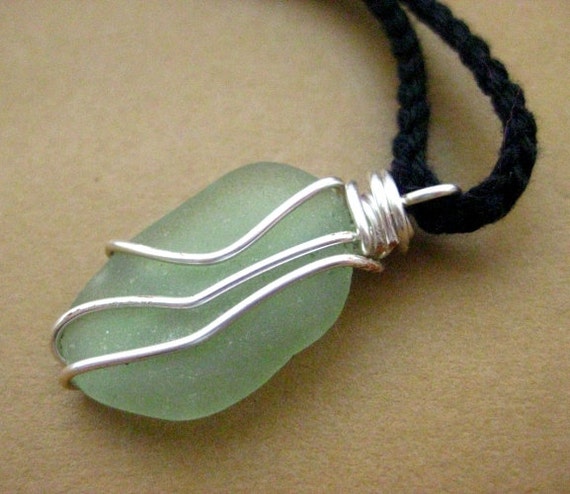
In Dublin city, it's relatively easy to get to the coast for some beach combing. I collect and use beach glass and sea pottery. Personally, I'm not a fan of shell jewellery. You are more likely to pick up some decent beach glass near a harbour, or in the tiny pebble coves than on a long sandy strand.

People often ask the difference between sea glass and beach glass. Sea glass is glass that has been naturally tumbled and frosted by salty, ocean water and is found on coastal strands. Glass that has been tumbled naturally by fresh water in lakes and rivers is called beach glass. Beach glass is also the wider term for both categories...in other words, sea glass can also be termed 'beach' glass but the reverse is not so.  Sea pottery can also fall under the term 'beach glass.'
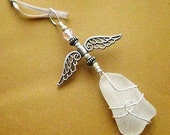
 Irish Angel. Sea Glass Fairy Suncatcher, Christmas Ornament or Rear View Mirror Charm
A fully frosted and smoothed piece of beach glass would have been surfing the waves getting buffed by the silt for decades. Frosting occurs when minerals are leeched by the elements over a long period of time.

I have written a number of previous posts around the subject including:
How to Clean Beach Glass
How to Care for Beach Glass Jewellery
A Little About Sea Pottery

bottle stoppers I found in Dublin
B is also for bottle stoppers - my favourite beach finds to date. Glass bottle stoppers were popular in these parts in the 1800s. This piece would have originally had a cork sheath around the shank and would have come from  a sauce bottle. Read more about the club sauce stopper HERE.