Showing posts with label headpins. Show all posts

Sunday, August 10, 2014

H is for Howlite, Hematite & Headpin. ABC of Jewellery

Heyho, we've reached letter H in my ABC of Jewellery. This is a not-so-comprehensive guide to jewellery materials and techniques I use as well as inspirations and design styles.  is for Howlite, Hematite and Headpin .
 
Natural howlite                             Dyed, 'turquoise' howlite
Howlite is a porous, fairly matte, opaque stone. It is most often dyed artificially and re-named with a marketing term such as 'turquoise howlite,' 'pink turquoise,' 'howlite jasper' 'lapis jade' and all sorts of poetic names. In its natural state it is usually grey or white and indeed, is also often confused with 'white turquoise,' a much rarer mineral. The fact is, howlite is not turquoise. It's not jasper, jade or any other stone. It is what it is, a borate mineral that doesn't take a great polish, but can be dyed easily in beautiful colours and is perfect for fun and affordable jewellery.

Metaphysically it is the stone associated with awareness and wisdom. Natural healers believe howlite brings calm and relaxation to a troubled or anxious mind, relieves pain and helps with insomnia.
magnetised hematite beads
Hematite is ferric oxide, or in plane English, a form of iron ore. It is a shiny, charcoal grey or black. In its raw state it often appears red due to rust. The name 'hematite' comes from the Latin 'blood stone,' in reference to the redness. Sometimes the beads can be a bit heavy and not a good choice for earrings.
double stranded pearl choker with hematite focal (own necklace)
Hematite is often magnetised, which can be tricky to work with, or very useful in certain designs. When beading the double-stranded pearl necklace above, I placed a magnetic hematite bead at the centre of both strands to keep them neatly together and help the choker sit well. I am working on variations of the design at the moment.
Magnetic hematatite beads keep the strands from separating
As it is a raw form of iron, natural healers  use its energies for treating blood disorders. It it also the stone associated with grounding, calming and and clarity of thought.

Headpins
Headpins are a type of finding frequently used in jewellery making. They are basically a long pin with a 'stopper' on the end used for wiring up earrings, pendants etc. They resemble straight pins used in sewing but come in a wide range of sizes and metals. The ends are most often flat, but you can find more decorative ones with a bead on the end, or indeed you can make your own out of wire, hammering the end. Alternatively you can form a spiral at the end to keep the bead or stone from slipping off. You will need to harden the spiral, for example, with a rubber hammer.
work in progress, beads threaded on headpins &1 finished piece
H is also for Handy Hints and How Tos, which you will frequently find on my blog. Some are tutorials, some are more general tips.

I could have sworn H was for something else important?  Woops, I forgot my Etsy shop, Handmade by Amo'r!!  Why choose handmade? Because of the quality, uniqueness and attention to detail.
***

Previous posts in this series
A  B  C  (plus C for Crimping D E F  (plus F for Findings) G1 and G2

All of this series: ABC


Friday, June 6, 2014

F is for Findings

Welcome to part 2 of the letter F in my ABC of Jewellery. The series is a not-so-comprehensive guide to jewellery, materials and techniques I use, inspirations and design. The letter F proved to cover quite a lot, so I divided it into two posts. Part 1 covered Fluorite, Feldspar, Fan necklaces and Fairies. Part 2 introduces you to the group of craft supplies called Findings. It so happens, I have a small bank of previous posts to help me here.
examples of jewellery findings
Findings are those little components used in jewellery making to connect, secure, enhance or hang either the other components (beads/stones etc) or the entire piece. Examples include earring hooks, charms and clasps but they encompass a long list of other small supplies from headpins to crimps and are mostly made of metal. All good jewellery craft suppliers will sell a wide range and the larger online suppliers often have clear explanations for usage.

If you have some experience in wire work, you can make many findings yourself quite easily from craft wire. I took a findings master class at Dublin store, Beads & Bling a few years ago, but you can find tutorials online. I include links in this article to any relevant tutorials I have written to date myself.
         

The simplest of findings is the humble jump ring. This is a basic ring of wire that can be open or soldered shut. If you are not a jewellery maker you can use an open jump ring for repairs such as re-attaching a clasp if you know the correct technique to ensure the ring closes tightly. I previously posted this insider tip How to open Jump rings & Loops You don't have to own a pliers to do this if you have a strong tweezers.

If you do have the basic tools, you can even make your own jump rings with a hard craft wire, such as gauge .80mm (20ga) or 1mm (18ga) and, when adept, in super hard 1.25mm (16ga). I don't do this often, as I prefer to wire wrap links instead but I do make the odd ring to use as a hanging bail for a pendant.


For full instructions on making jump rings please refer to my recent post How to Make Jump Rings...

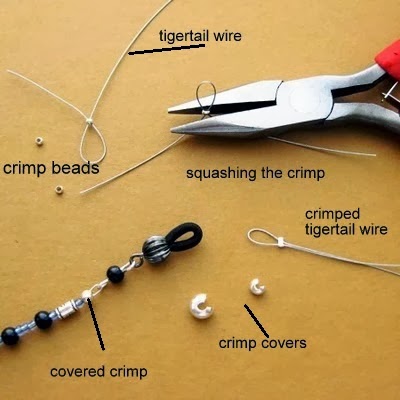
There are several ways to finish a beaded string but my method of choice is to use metal crimps and covers. I previously wrote a tutorial on How to Use Crimps  which may be of use to beginner beaders or of interest to those who have only ever used knotting techniques.
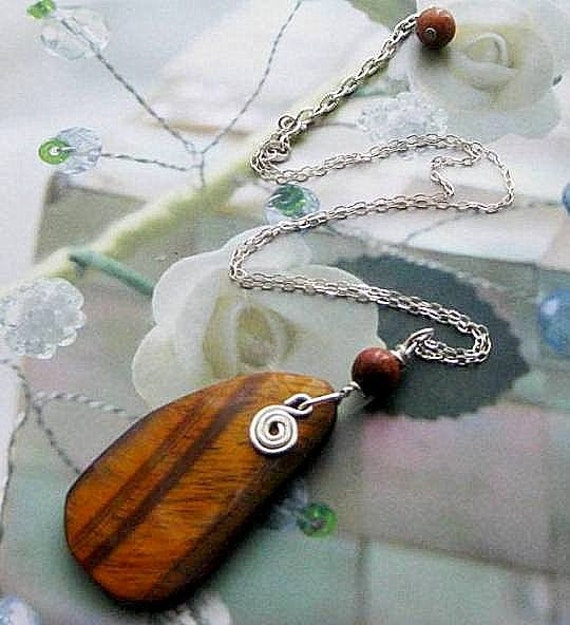
tiger eye pendant with spiral charm detail

Small metal charms can also be classified as findings. These are tiny pendant-like motifs that you can attach   onto  extender   chains,  charm  bracelets,  flat stones  and  to  other  findings  for decorative purposes.


A typically Irish symbol that only requires the same basic pliers set and wire to make is the Celtic spiral. For instructions please refer to my previous post How to Make Spiral Charm. 


It is preferable to hammer most of your handmade findings and charms to make them strong and rigid. Again, here's one I made earlier: How to Harden Charms and Findings with a Rubber Hammer. A chasing hammer (middle photo) can also add texture.


Other basic tools required if making your own findings are a set of metal files for softening sharp ends of wire and an agate burnisher for finishing the job by smoothing. A burnisher is also useful for polishing and for smoothing little nicks and bumps in metal.

F is also for Friday...so have a good one and a fun filled weekend!

***

CLICK HERE FOR THE ABC SERIES SO FAR

or by letter:
A  B  C  (plus C for Crimping D E F